
How to Choose Balloons and Backdrops for an Event
You have 37 screenshots saved to your phone.
One has a gorgeous balloon installation. Another has the perfect backdrop. A third is in a venue roughly six times the size of yours, but we’re ignoring that for now because the colors are so good.
And somewhere along the way, “I think I want balloons” became “Wait, do I need a backdrop too?”
This is where event decor gets confusing.
You don’t need to know the difference between a Chiara wall and a shimmer wall before contacting a decorator. You also don’t need to have the entire design figured out. But understanding a few basics can help you spend your budget where it will actually show, choose a setup that fits your venue, and avoid paying for decor that ends up sitting somewhere nobody notices.
So, balloons? Backdrop? Both?
Here’s how to decide.
Should You Get Balloons, a Backdrop, or Both?
Choose balloons when you want color and dimension, a backdrop when you need a defined focal point or photo area, and both when you want a larger statement installation. For most events, one well-designed balloon-and-backdrop focal point creates more impact than spreading smaller decorations throughout the room.
When balloons alone work best
Sometimes balloons are all you need.
If your venue already has a great wall, beautiful windows, exposed brick, greenery, or another feature worth keeping visible, covering it with a backdrop doesn’t automatically improve things.
A balloon installation can frame what’s already there. It can work around a sign, over an entrance, beside a stage, near a staircase, around a dessert display, or as a freestanding feature in a space that needs some color and height.
This is especially useful when you want the room itself to remain part of the design.
When a backdrop does more of the work
Then there are venues with… less cooperative walls.
You know the ones… Beige ballroom partition. Exit sign. Thermostat. Random framed print that has absolutely nothing to do with your baby shower but you can’t move it.
This is where a backdrop allows you to exercise control over what people see. It can create a dedicated photo area, frame a cake or head table, give corporate branding somewhere to live, or simply cover a section of the room that you’d rather not have starring in every picture.
When balloons and backdrops make sense together
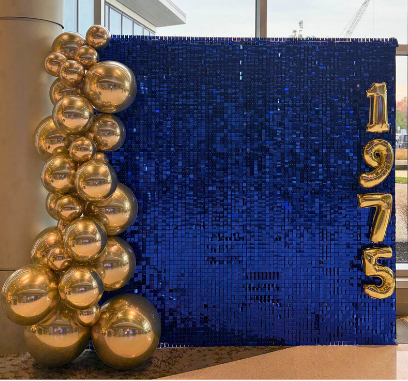
This is where the two really work well. The backdrop gives the setup shape and structure. The balloons bring in dimension, movement, and color.
For birthdays, graduations, showers, weddings, corporate events, and school celebrations, that combination can turn one section of the room into the place everyone notices. And the balloons do not have to swallow the backdrop whole.
A lot of great installations use balloons on one side or across part of the design so the backdrop, custom signage, logo, or graphics can still do their job.
When you probably don’t need either everywhere
This is where I will happily talk someone out of more decor– I know, you’re questioning my sales skills at this point. Totally valid!
You usually do not need a balloon installation in every empty corner of the venue.
If the budget is $1,000, I’d much rather see that money create one area that looks fantastic than five small pieces that barely register once the room fills with people.
Think about where guests will enter. Where will they gather? Where will they take pictures? Put the visual punch there.
Which Balloon and Backdrop Combination Will Look Best at Your Event?
There isn’t one magic setup that works for every occasion.
A 40th birthday has different needs than a baby shower. A corporate event should not look like someone took a birthday backdrop and slapped a logo on it five minutes before guests arrived.
The design should start with the event.
Birthdays and milestone celebrations
Birthdays give you room to have fun with scale, color, and personality.
You can pull the palette from an invitation or theme, incorporate a name or age into the backdrop, add marquee numbers, or build the entire setup around one statement element.
Milestone birthdays can support a bigger visual moment because the number itself is part of the story.
A 50th birthday in a ballroom might call for oversized marquee numbers, a layered backdrop, and a substantial balloon installation. A 30th birthday dinner for 20 people may need far less.
Same occasion category, but a totally different room.
Bridal showers, baby showers and weddings
These setups are often photographed constantly, which changes how you design them.
The backdrop needs to work when someone is standing directly in front of it, but it also needs to make sense from across the room.
Layered arches, softer palettes, florals, custom names, and less aggressive balloon coverage often work beautifully here. The surrounding furniture matters, too.
If the installation is behind a sweetheart table, cake display, or seating area, it should be designed with that furniture in mind. Otherwise, you can end up paying for a backdrop that spends the whole event hidden behind chairs and centerpieces.
Graduations and school events
Graduation decor practically begs to be photographed.
School colors, grad years, giant numbers, custom signs, and balloons all make sense because the purpose of the setup is instantly clear. The question people forget to ask is: how many people need to fit in front of it?
A backdrop that looks perfect behind one graduate can get real awkward real fast when seven friends decide they all need the photo. For events with big groups who will all want to get in the shot at once, trust me– width matters.
Corporate events and brand activations
Corporate decor has more work to do.
It might need to create a branded photo area, frame a stage, mark an entrance, support a product launch, or make a conference space feel less like… well, a conference space.
Logo placement matters here, and it matters BIG TIME. If the balloons cover the logo or the branding sits so low that everyone blocks it in photos, you’ve missed the point.
The same goes for brand colors. “Close enough” blue may be fine for a birthday. It’s less fine when the company has spent years building a visual identity around a very specific blue.
What Types of Backdrops Work With Balloon Decor?
“Backdrop” covers a lot of ground.
A shimmer wall and a solid arched panel can support the exact same balloon colors and still give you two completely different looks.
That’s why the backdrop should be part of the design decision, not something tacked on afterward.
Chiara and arched panel backdrops
Arched panels are popular for a reason: they play nicely with a lot of styles.
You can use one panel for something simple or layer several at different heights. They can be painted or covered in custom colors and finished with vinyl lettering, signs, florals, or graphics.
They also give balloons something to frame without making the entire setup feel heavy.
Shimmer walls
Shimmer walls are not shy.
They reflect light, add texture, and give you movement even before a single balloon goes up.
They work especially well for milestone birthdays, proms, corporate celebrations, school events, and events where the goal is a little more “look at me.”
Because the wall itself already has a lot going on visually, you often need less around it than you think.
Greenery, flower and textured walls
Greenery and floral walls bring texture into the setup before balloons are added.
They’re a natural fit for showers and weddings, but they can also work for corporate events where a printed logo wall would feel too formal.
Neutral balloons against greenery can look completely different from the same balloons against a solid white panel. Backdrop texture changes the whole vibe.
Custom and branded backdrops
Sometimes an off-the-shelf rental just isn’t going to cut it.
A custom backdrop can incorporate a company logo, campaign artwork, guest name, school identity, event phrase, or graphics created specifically for that occasion.
That matters when the backdrop needs to say something, not just fill a wall.
Layered backdrop installations
Multiple panels create more depth and can make a setup feel larger without requiring a massive footprint.
Different heights also give you more options for signage and balloon placement.
In larger venues, layering can keep the backdrop from looking like one lonely little panel standing against a 30-foot wall wondering what happened.
How Big Should Your Balloon and Backdrop Setup Be?
This is one of the biggest differences between a setup that looks right and one that looks accidentally miniature.
The dimensions in an inspiration photo don’t tell you much unless your venue happens to be the exact same size.
Start with what the backdrop needs to accomplish
Who is using it? Is it one person? A couple? A family of five? Twelve employees who will absolutely insist on squeezing into one picture?
A setup designed for portraits can be narrower. A group-photo backdrop needs more width. Something sitting behind a head table needs to relate to the width of the table.
That’s where you should start.
Match the installation to the venue
Scale changes everything. A six-foot backdrop can look substantial in a home. Put it against a giant ballroom wall with 18-foot ceilings, and suddenly it looks like somebody forgot half of it in the van.
Ceiling height, wall width, furniture, and viewing distance all affect how large the decor appears.
This is why venue photos are so helpful when planning an installation.
Don’t forget photography distance
You need space in front of the setup, too.
If guests are going to use the backdrop for photos, they need somewhere to stand, and whoever is taking the picture needs somewhere to go.
A fantastic backdrop wedged between banquet tables with three feet of clearance in front of it is going to be frustrating all night.
For group photos, plan for even more breathing room.
Account for doors, outlets, fire exits and traffic flow
Here comes the deeply unsexy part of event design– but probably the most important, as it comes down to safety and legal issues.
The perfect wall may also contain the fire exit. Or the only outlet. Or the doorway catering needs to use 47 times during dinner.
Sprinklers, venue rules, loading restrictions, guest traffic, and emergency access can all affect where decor can safely go.
A good plan accounts for that before installation day. (Talk to me later about the two hour install of a boxwood greenery wall in 35mph winds that was finally up, secured, and tested and as I’m walking away, someone casually asks me if I can “move it just 18 inches to the right.”)
Where Should Balloons and Backdrops Go at an Event?
The best location is usually somewhere guests will naturally see, approach, or photograph. Guess what? It’s not automatically the largest blank wall.
Behind the guest of honor or head table
For birthdays, showers, weddings, and graduations, this makes a lot of sense because the decor becomes part of the event instead of an isolated photo station.
It also shows up naturally in pictures throughout the day.
At the entrance
Entrance decor gives guests an immediate visual cue that they’ve arrived.
It can work particularly well when the venue entrance itself is plain or when you need to distinguish your event from everything else happening in the building.
Behind a dessert or cake display
This can create one strong visual area without requiring decor throughout the room. But scale of the individual pieces has to be a huge consideration.
A massive backdrop with a tiny cake table can look strange. A huge dessert spread in front of a narrow backdrop can swallow it completely.
In a dedicated photo area
If photos are a priority, make the location obvious– don’t make people try too hard to find the photo op!
Give people enough room to stand in front of the setup. Check the lighting. Make sure someone taking a group picture can back up without ending up in the buffet.
These small details make a big difference.
Near a stage or corporate presentation area
For conferences, awards, fundraisers, and school events, decor can frame a presentation area and make the stage look far better in photos.
Just keep screens, speakers, entrances, and audience sightlines clear.
Nobody needs a six-foot balloon cluster blocking Slide 12.
How Do You Choose Balloon Colors That Work With a Backdrop?
Choosing colors from a screenshot is easy.
Choosing colors that still work when they’re surrounded by carpet, chairs, wallpaper, lighting, flowers, signage, and whatever else is happening in the room is a little different.
Start with the venue before choosing your palette
Look at the space; if the room has dramatic wallpaper, dark wood, burgundy carpet, or a giant wall of windows, that information matters.
You don’t have to match the venue, but you do need to know what your colors are going to sit next to.
Use different tones instead of exact matches
Using several tones within a color family can give balloon decor far more depth.
Instead of repeating one shade of pink 150 times, you might use blush, dusty rose, mauve, and a deeper accent.
That variation keeps the installation from reading as one flat block of color.
Decide whether the backdrop should blend or contrast
Sometimes the backdrop should stay quiet while the balloons carry the color. Other times, a contrasting backdrop is what makes the entire setup work. Neither is automatically better.
The question is what you want people to notice first.
For corporate events, start with the brand guidelines
Corporate clients often have exact color references (HEX, RGB, CMYK) and rules for how logos should appear— my goodness, use them!
The decor doesn’t have to reproduce an entire brand book in balloon form, but it should look like it belongs to the company.
If those event photos end up on LinkedIn, in internal communications, or in press coverage, that detail matters.
How Much Do Professional Balloons and Backdrops Cost?
There isn’t one standard price because there isn’t one standard installation.
A small garland over a dessert table and a ballroom-scale balloon-and-backdrop installation aren’t comparable jobs.
Pricing usually comes down to the size of the design, materials, customization, installation time, delivery, and venue requirements.
What affects balloon decor pricing?
The number of balloons matters, but that’s only part of it.
Size, specialty colors, design complexity, onsite construction, installation height, delivery distance, teardown requirements, and venue access can all change the price.
A setup that looks effortless in a finished photo may have taken hours to prepare before the decorator ever walked into the venue.
What affects backdrop rental pricing?
Backdrop cost varies based on the style, number of panels, customization, signage, florals, graphics, and whether anything needs to be fabricated specifically for the event.
Logistics can affect the cost too. There is a substantial difference between rolling everything through a ground-floor door and hauling it through a loading dock, into a freight elevator, down two hallways, and across a ballroom before the 45-minute setup window closes.
Why the Pinterest photo doesn’t tell you the price
(… or maybe it’s telling you an Amazon price.)
This question comes up all the time: “How much would something like this cost?”
The honest answer is that the photo usually leaves out most of the information needed to answer that.
You may not know the dimensions, balloon count, materials, custom fabrication, floral work, equipment, setup time, delivery distance, or even whether part of the installation belongs to the venue.
Inspiration photos are incredibly helpful for showing style, but they are terrible price tags.
What can you do if you have a fixed decor budget?
Tell your decorator what it is. EVERYONE HAS A BUDGET– I have yet to work with anyone who has said, “the sky is the limit.” (But if you’re that person, let’s talk… because I have INSANELY AWESOME ideas!)
That is useful information, not something you need to hide.
If the budget is limited, a decorator can help decide where it will show the most. That may mean creating one substantial photo area instead of putting a small balloon piece at the entrance, another near the bar, something behind the cake, and then wondering why none of it feels substantial.
At Wonderwall Event Co., onsite installations begin at $500. Final pricing depends on the size of the project, location, materials, and customization involved.
Is Professional Event Decor Worth It Compared With DIY?
DIY is not automatically a bad idea.
There are absolutely events where it makes sense.
There are also events where the phrase “we can totally do this ourselves” has ruined somebody’s Friday night.
DIY can make sense when…
A small installation at home can be very manageable, particularly if you have plenty of setup time and genuinely like doing this kind of project.
If you don’t mind transporting supplies, building the piece, and troubleshooting anything that goes sideways, have at it.
Hiring a decorator makes more sense when…
The equation changes when you’re dealing with a larger setup, strict venue access times, rental pieces, difficult installation areas, or an event where the decor really needs to photograph well.
It also changes when you’d rather spend the morning of your event doing literally anything else.
There’s a real benefit to walking into the venue and finding the decor already done.
The cost people forget to include in DIY
DIY comparisons often start with the cost of the balloon kit.
Then reality arrives. You may also need a pump, fishing line, hooks, weights, stands, adhesives, hardware, tools, transportation space, and enough extra material to fix whatever decides not to cooperate– inexpensive balloon kits become far more expensive when you figure out those photos were created using MULTIPLE kits.
And then there’s your time.
If you enjoy doing balloon inflating and installation, that’s awesome. But if inflating balloons at 11:46 p.m. the night before your event sounds like your personal version of hell, that’s worth factoring into the decision too.
What Should You Ask an Event Decor Company Before Booking?
The Instagram grid is only part of the story.
You also need to know what happens between “yes, we’re available” and the moment your guests walk in.
Do you deliver, install and remove the decor?
Find out exactly what your quote includes. Will the company bring everything to the venue? Install it? Return later for rental pieces?
You do not want to discover at 10 p.m. that a seven-foot backdrop somehow became your responsibility to transport home.
Are you insured?
This is a HUGE one, especially for corporate or school-related events like a prom. Many hotels, schools, country clubs, corporate properties, and event venues require outside vendors to carry liability insurance.
Ask before booking. It’s much easier than learning about the requirement a week before the event.
Have you worked at my venue before?
While it isn’t mandatory, previous experience at a venue can be helpful.
More important is whether the company knows how to communicate with venue staff, follow installation rules, get the information it needs, and work within the allotted setup window. Having a previous relationship with an event manager allows you special perks that are not often doled out to first-timers.
Who handles venue requirements and setup windows?
Someone needs to know where vendors load in, when access begins, what the venue prohibits, and how pickup works– so find out who is handling that communication.
This is especially important at hotels, stadiums, universities, and corporate venues where “just pull up to the front door” is usually not an option.
Can you create custom colors, signage or branding?
Ask what can actually be personalized.
That may include backdrop colors, vinyl lettering, logos, custom signs, graphics, themed elements, or balloon palettes.
If customization is one of the reasons you’re hiring a professional, this is worth discussing early.
What happens if the event timeline changes?
Events run late… very late, sometimes.
Ask how the company handles changes to installation times, event end times, and pickup schedules, including whether additional fees apply. It’s far better to know the policy beforehand.
How Far in Advance Should You Book Balloons and Backdrops?
Earlier is better if you need a specific rental piece, custom fabrication, or a larger installation.
Certain dates also disappear faster than others.
Graduation season can get packed. So can popular wedding weekends, school-event season, and December corporate events.
A simpler setup may be possible with much less notice.
If your event is coming up soon, ask anyway. Availability depends on the date and the size of the project, and sometimes there’s still room.
What Information Should You Send a Decor Company for a Quote?
To get an accurate balloon and backdrop quote, send your event date, venue, event type, color palette, inspiration photos, approximate budget, and a photo or measurements of the installation space.
The most useful information to send is:
- Event date
- Venue and city
- Type of event and estimated guest count
- Color palette or company brand colors
- A few inspiration photos
- Approximate decor budget
- Photos or measurements of the installation area
Then answer one more question:
What is the one thing you most want guests to notice?
That can tell a decorator far more than 25 screenshots.
Maybe the backdrop needs to be the photo destination.
Maybe the cake is the star.
Maybe every picture needs to include the company logo.
Maybe your daughter wants disco balls everywhere and subtlety has officially left the building.
Now we know what the decor needs to do.
How Do You Turn Balloons and Backdrops Into a Full Event Moment?
Sometimes the setup looks finished with balloons and a backdrop.
Sometimes it needs something else.
That doesn’t necessarily mean more balloons.
Add custom signage
A name, phrase, logo, or event title immediately makes the backdrop specific to the occasion.
It’s also one of the easiest ways to carry a theme or company identity without adding more physical decor throughout the room.
Incorporate marquee letters or numbers
Marquee letters and numbers work especially well for milestone birthdays, graduations, anniversaries, school events, and corporate celebrations.
They can add light and scale while becoming part of the main installation rather than a separate rental sitting off by itself.
Add florals or dimensional props
Florals, greenery, disco balls, themed props, and other dimensional pieces can bring in texture or reinforce the event theme.
The trick is knowing when to stop.
Every available decorative object does not need to join the party.
Use lighting intentionally
A beautiful backdrop in terrible lighting is still going to photograph terribly.
If the setup will be used for pictures, look at the light in that area before the event.
For evening events or darker venues, additional lighting may make more difference than another five feet of balloons.
How Do You Choose the Right Decor Company for Your Event?
Look at the portfolio first… then look harder.
Do the installations fit the venues they’re in? Can the company handle different styles and scales, or does every event look like a version of the same setup?
Read reviews for clues about communication and reliability, not only comments about how pretty everything looked.
Ask about insurance. Contracts. Venue coordination. Setup and pickup. Find out exactly what happens on event day– because yes, the finished setup needs to look great.
But somebody also has to get the correct pieces into the correct room at the correct time, install them safely, deal with whatever weird venue issue pops up, and have it all ready before your first guest walks through the door.
That part never makes the Instagram reel, but it matters in a big way.
If you’re planning a private celebration, corporate event, school function, or other event in Maryland, Wonderwall Event Co. creates custom balloon decor, backdrops, marquee rentals, signage, and event installations.
Send us your event date, venue, approximate budget, and whatever inspiration you already have.
And if your entire design brief is currently, “I know I want it to look really good, but I have no idea what I’m doing,” that’s enough to start.
Leave a Reply

Wonderwall Event Co. is committed to making our website accessible to everyone. We strive to meet WCAG 2.1 Level AA standards and continually improve the user experience for all visitors. If you experience difficulty accessing any part of our site, please contact us at jen@wonderwalleventco.com and we’ll gladly assist.
